Built for robotics development, drone vision, and edge AI prototyping on the NVIDIA Jetson Orin Nano, this camera pairs the Onsemi AR2020 sensor with VCM autofocus over MIPI CSI-2, giving developers genuine 20MP detail and consistent focus validated specifically for the Orin Nano’s compact edge AI compute platform.
SAN JOSE, CA / ACCESS Newswire / September 3, 2026 / Vadzo Imaging, a world leader in embedded vision solutions, today validated the Bolt-2020CRH, a 20MP VCM Autofocus MIPI Camera built around the Onsemi AR2020 sensor for robotics development, drone vision, and edge AI prototyping applications specifically validated for the NVIDIA Jetson Orin Nano platform.
Why Orin Nano Robotics and Drone Projects Need a 20MP VCM Autofocus MIPI Camera Built for Their Specific Platform
Developers building on the NVIDIA Jetson Orin Nano specifically, rather than a larger Jetson module or a different single-board computer entirely, need a camera validated against that specific platform’s actual MIPI CSI-2 implementation and driver stack. A camera that works on a different Jetson module is not automatically guaranteed to work the same way on the Orin Nano, since driver support and camera interface details can vary meaningfully even within the same broader product family. A 20MP Orin Nano Camera addresses that platform-specific gap directly, validated against the Orin Nano’s actual hardware rather than a general Jetson family assumption.
An AR2020 VCM Autofocus MIPI Camera addresses that platform-specific compatibility directly, validated against the Orin Nano rather than assumed compatible based on general Jetson family support. An NVIDIA Orin Nano Camera configuration like this one gives robotics and drone developers confidence that a camera will actually work on the specific board they are building around, rather than requiring their own driver validation work.
A second, related challenge for robotics and drone applications specifically is maintaining focus as a vehicle or aircraft moves through varying distances to its subject or environment. An AR2020 Jetson MIPI Camera configuration addresses that challenge with VCM autofocus, adjusting focus electronically as working distance changes during flight or ground-based navigation.
Neither challenge exists on its own in a real robotics or drone project. A camera validated for the Orin Nano but limited to a single fixed focus distance still fails the moment a robot or drone’s actual working distance shifts, and a camera with excellent autofocus but unvalidated Orin Nano compatibility still leaves a developer absorbing driver integration risk they should not have to take on. Solving both from the same camera platform is what makes a camera genuinely suited to Orin Nano-based robotics and drone development.
Engineering Explanation: Platform Validation and Autofocus Together
Onsemi designed the AR2020 to deliver 20 megapixel resolution in a package genuinely suited to demanding edge AI applications, and Vadzo Imaging validates the Bolt-2020CRH specifically against the Orin Nano’s MIPI CSI-2 interface and driver stack rather than assuming compatibility from broader Jetson family support. As an Onsemi AR2020 Jetson Sensor, the module gives robotics and drone developers real detail to work with on hardware already confirmed to work with their specific board.
That platform-specific validation matters directly for VCM autofocus performance as well. As an AR2020 Orin Nano Sensor, the Bolt-2020CRH’s autofocus mechanism has been tested against the Orin Nano’s actual processing and timing characteristics, and an Orin Nano Autofocus Camera configuration like this one gives developers confidence that focus behavior will perform as expected on the specific board their project is built around.
MIPI CSI-2 connectivity completes the platform-specific design. As an AR2020 Jetson MIPI Camera, the Bolt-2020CRH connects directly to the Orin Nano’s native camera interface, and an AR2020 CSI-2 Jetson Sensor configuration like this one avoids the additional bridging hardware a mismatched interface would require.
Resolution and autofocus work together to give developers genuine flexibility for both robotics navigation and drone vision tasks. As a 20MP Autofocus MIPI Camera, the Bolt-2020CRH resolves fine detail regardless of where autofocus settles within its working range, and a 20MP Autofocus MIPI CSI-2 Camera configuration like this one gives Orin Nano developers a single camera platform for both close-range robotics tasks and longer-range drone vision.
Product Overview
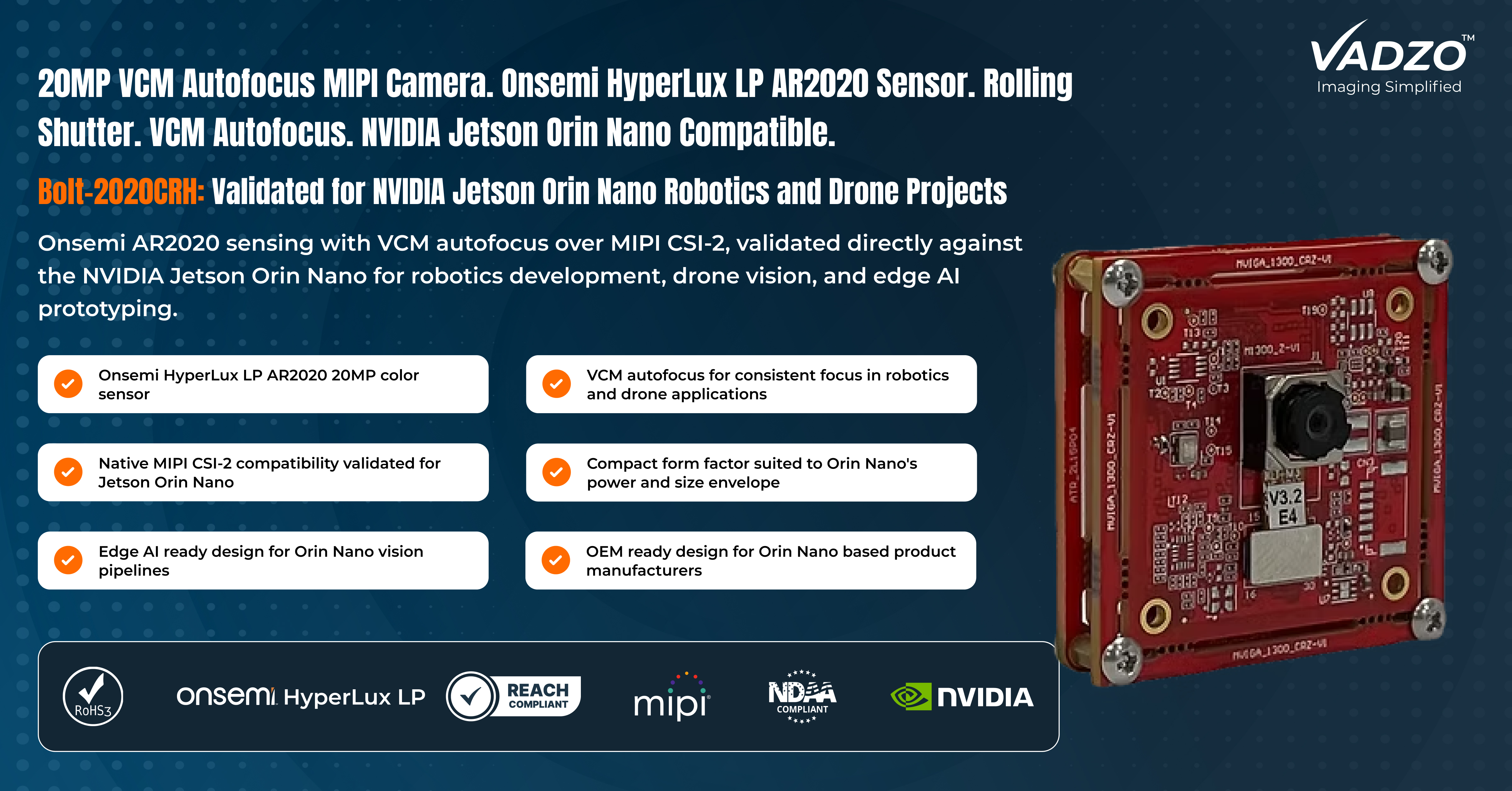
The Bolt-2020CRH pairs the NVIDIA Orin Nano Camera sensor with VCM autofocus in a compact design suited to robotics, drone, and edge AI development on the Orin Nano platform. As a 20MP Orin Nano MIPI Camera, it outputs full 20-megapixel resolution with autofocus active by default, giving developers a single camera platform validated specifically for their Orin Nano-based project.
At the core of the module sits the Onsemi HyperLux LP AR2020 Sensor, chosen specifically for the combination of resolution and autofocus flexibility that robotics and drone applications on the Orin Nano require. Because the camera pairs 20MP Orin Nano-compatible camera validation with 20MP Jetson MIPI Camera connectivity, the Bolt-2020CRH reaches usable image quality across both close-range robotics tasks and longer-range drone vision from the same hardware.
Product Specifications
Key specs: 20MP (5120 × 3840) Max Resolution | Onsemi HyperLux LP AR2020, 1/1.8-inch Sensor Format | 1.4 µm Pixel | Color, Rolling Shutter | MIPI CSI-2 Interface | VCM Autofocus Optics
Key Capabilities
Onsemi AR2020 Sensor for Detailed 20MP Capture on Orin Nano: The Bolt-2020CRH is built around the Onsemi AR2020 sensor, a device that resolves genuine 20 megapixel detail for robotics and drone vision applications running on the Orin Nano platform specifically. This gives the module 4K Orin Nano Camera performance suited to edge AI tasks that need real detail to work with, validated against the exact board developers are actually building around. That validation matters directly for a project’s development timeline, since discovering a compatibility gap after a robotics or drone platform has already been designed around a specific camera is far more costly than confirming compatibility before committing to a hardware choice.
VCM Autofocus for Consistent Focus in Robotics and Drone Applications: Robotic vehicles and drones encounter constantly changing distances to their subject or environment as they move and navigate, which makes a fixed focus lens a genuine limitation for these specific applications. The Bolt-2020CRH’s VCM autofocus adjusts electronically as that distance changes, keeping a robotics or drone vision pipeline supplied with sharp, usable frames regardless of how far the platform happens to be from what it is observing at any given moment.
Native MIPI CSI-2 Compatibility with Jetson Orin Nano: A camera validated against the Orin Nano’s specific MIPI CSI-2 implementation avoids the driver compatibility issues that can arise when a camera is only tested against a different Jetson module or assumed compatible based on general family support. As an Orin Nano Vision System, the Bolt-2020CRH connects directly to the Orin Nano’s native camera interface, reducing the validation risk developers would otherwise absorb themselves. As an Orin Nano MIPI Camera, it delivers that native connectivity specifically validated for the Orin Nano’s MIPI CSI-2 implementation.
Compact Form Factor Suited to Orin Nano’s Power and Size Envelope: The Orin Nano is specifically popular for robotics and drone projects because of its compact size and moderate power envelope compared to larger Jetson modules, and a camera paired with that board should not undermine those same size and power advantages. The Bolt-2020CRH’s compact design keeps the overall platform’s footprint and power budget aligned with the reasons developers chose the Orin Nano in the first place. That alignment matters most for battery-powered platforms like drones, where every additional gram of camera hardware and every additional milliwatt of power draw directly reduces flight time or operating duration.
Edge AI Ready Design for Orin Nano Vision Pipelines: Edge AI vision pipelines running on the Orin Nano depend on a consistent, detailed video feed to maintain inference accuracy across a robotics or drone application’s full operating range. As an Orin Nano Edge AI Camera, the Bolt-2020CRH supplies that consistent feed, giving developers confidence that their vision pipeline receives the same quality input regardless of the specific distance or lighting condition a given moment presents. That consistency matters directly for inference accuracy, since a machine learning model trained on consistent input data tends to perform more reliably than one that must compensate for variable image quality between frames.
OEM Ready Design for Orin Nano Based Product Manufacturers: Manufacturers building products around the Orin Nano at scale need a camera platform that stays consistent across a long production run. Vadzo Imaging supports full customization on this platform as an Orin Nano Camera Manufacturer, including connector changes, optics selection, and firmware adjustments for manufacturers headed into volume production across multiple Orin Nano-based product lines. That customization extends to autofocus range tuning as well, since a manufacturer building a close-range robotics manipulation product may need a different focus profile than one building a longer-range drone vision system, even though both rely on the same underlying sensor and Orin Nano platform.
“Developers building robotics and drone projects on the Orin Nano keep telling us the same thing: a camera that claims general Jetson compatibility does not always behave the same way on their specific board, and discovering that gap mid-project costs real development time. The Bolt-2020CRH is validated directly against the Orin Nano, giving developers genuine confidence that VCM autofocus and MIPI CSI-2 connectivity will work exactly as expected on the board they are actually building around. We built this camera for the Orin Nano specifically, not a general Jetson family assumption.” – Alwin Vincent, Product Manager at Vadzo Imaging.
Application-Specific Sections
Orin Nano Powered Robotics Development: Robotics development on the Orin Nano depends on a camera that maintains focus as a robot moves through varying distances to obstacles, navigation markers, or manipulation targets. As an Orin Nano Robotics Camera, the Bolt-2020CRH’s VCM autofocus supports that adaptive focus, and functioning as an NVIDIA Jetson Camera Module, it validates directly against the specific Orin Nano hardware most robotics developers are already building around.
Drone and UAV Vision on Orin Nano: Drone and UAV vision applications running on the Orin Nano need a camera that holds focus as altitude and distance to the ground or a tracked subject change throughout flight. As an Orin Nano Drone Camera Module, the Bolt-2020CRH supports in-flight focus adjustment, and an NVIDIA Jetson MIPI CSI-2 Camera configuration of the same module gives drone developers confidence in direct hardware compatibility.
Edge AI Prototyping with Orin Nano Developer Kits: Edge AI prototyping on Orin Nano developer kits benefits from a camera that developers can trust works correctly from the first integration attempt, without absorbing driver validation risk themselves. As an Orin Nano Developer Kit Camera, the Bolt-2020CRH supports that confidence, and functioning as a Jetson Orin Nano Vision Kit, it integrates directly into a developer’s existing Orin Nano-based prototyping workflow.
Orin Nano Vision Systems for Embedded Products: Embedded products built around the Orin Nano need a vision component that matches the platform’s validated, production-ready status rather than introducing a new, unvalidated variable into an otherwise proven design. As an Orin Nano Machine Vision Camera, the Bolt-2020CRH supports that production readiness, and an Orin Nano Embedded Vision Camera configuration of the same module extends the same reliability to broader embedded vision product designs. That reliability matters directly for manufacturers who have already invested significant engineering time validating an Orin Nano-based product design, since introducing an unvalidated camera component late in that process reintroduces exactly the kind of integration risk a mature product design is meant to eliminate.
OEM Integration for Orin Nano-Based Product Manufacturers: Orin Nano-based product manufacturers building their own robotics, drone, or embedded vision hardware need a camera vendor who has already done the platform-specific validation work. The Bolt-2020CRH ships from a vendor with that Orin Nano validation already complete, and Vadzo Imaging supports OEM customization for cable length, connector type, and firmware for manufacturers standardizing on one camera across multiple Orin Nano-based product lines. As an Orin Nano MIPI CSI-2 Camera Module, it fits directly into a manufacturer’s existing Orin Nano platform architecture.
Frequently Asked Questions
Q: Why does NVIDIA’s Orin Nano specifically suit robotics and drone prototyping compared to other Jetson modules?
A: The Orin Nano occupies a specific position within NVIDIA’s broader Jetson lineup, offering a compact form factor and a moderate power envelope that fits comfortably within the size and battery constraints a robotics or drone platform typically presents, without the larger footprint and higher power draw of NVIDIA’s more powerful Jetson modules built for heavier production workloads. That balance of size, power, and edge AI performance is specifically why developers building on constrained platforms like a small robot chassis or a drone gravitate toward the Orin Nano rather than a larger module offering more compute than the application actually needs. The Bolt-2020CRH is validated directly against the Orin Nano specifically because that platform’s particular constraints and popularity among robotics and drone developers make it a distinct target worth validating against on its own, not simply an assumed subset of general Jetson family compatibility.
Q: Why does a drone or robotics camera need VCM autofocus specifically, rather than a fixed focus lens?
A: A robot moving through a workspace or a drone in flight constantly changes its distance to whatever it is observing, whether that is an obstacle, a navigation marker, or a tracked subject on the ground, and a fixed focus lens tuned for one assumed distance produces a blurred, unusable frame the moment actual distance shifts even modestly from that assumption. VCM autofocus adjusts electronically to hold focus as that distance changes throughout a robot’s navigation cycle or a drone’s flight path, which matters directly for vision pipelines that depend on sharp, usable frames to make navigation or detection decisions in real time. The Bolt-2020CRH builds VCM autofocus in specifically because robotics and drone applications rarely operate at one single, predictable distance throughout an entire mission.
Q: Does a camera need to be specifically validated for the Orin Nano, or does general Jetson compatibility cover it?
A: General Jetson family compatibility does not automatically guarantee identical behavior on every specific module, since different Jetson boards can vary in their camera driver implementation, MIPI CSI-2 timing characteristics, and available processing headroom, even when they share the same broader software ecosystem. A camera only tested against a different Jetson module leaves Orin Nano developers to discover any compatibility gaps on their own, often well into a project’s development timeline when switching hardware is costly. The Bolt-2020CRH is validated directly against the Orin Nano specifically so developers do not have to absorb that platform-specific validation risk themselves. That platform-specific validation typically covers driver installation, camera enumeration, and confirmed frame rate and resolution performance under the Orin Nano’s actual processing conditions, rather than a general claim of family-wide compatibility.
Q: Can Vadzo Imaging customize a MIPI camera module for a specific Orin Nano-based robotics or drone platform?
A: Yes. Vadzo Imaging supports full OEM customization on the Bolt-2020CRH, including optics selection suited to a specific working distance or field of view, connector and cable configuration matched to a particular robotics chassis or drone airframe, and firmware adjustments tuned for a specific autofocus range or speed profile. Evaluation units ship with no minimum order requirement, and the same engineering team that built the standard product works directly with developers and OEM integrators to adapt the module for a specific Orin Nano-based robotics, drone, or embedded vision platform headed into volume production.
Q: What should developers and OEM integrators look for when choosing a camera for an Orin Nano-based robotics or drone project?
A: A camera that works well in a quick bench demo does not necessarily deliver the same reliability once integrated into a real robotics or drone platform operating continuously in the field with constantly changing distances and lighting conditions. Developers should look for genuine platform-specific validation against the Orin Nano rather than a general Jetson family compatibility claim, autofocus performance proven across a realistic working distance range rather than a single demonstrated distance, and a supplier able to support the transition from prototype to production without a hardware change. The Bolt-2020CRH is built around exactly these priorities, since a robotics or drone project deserves a camera validated against the specific board it is actually being built around, not one assumed compatible based on a broader product family.
Availability
The Bolt-2020CRH 20MP VCM Autofocus MIPI Camera is available now and ready for evaluation and OEM integration. Evaluation kits include the camera module, mounting hardware suited to common Orin Nano developer kit configurations, and integration documentation covering VCM autofocus setup and Orin Nano driver installation, with no minimum order requirement. Contact Vadzo Imaging at support@vadzoimaging.com to request an evaluation unit or discuss volume production and OEM customization. Evaluation feedback is also welcome directly through the same contact channel, since real robotics and drone deployment conditions often surface details a bench test alone would not reveal, and that feedback helps confirm a configuration before a manufacturer commits to a full production order.
About Vadzo Imaging
Vadzo Imaging develops embedded and machine vision camera products for OEMs, system integrators, and edge AI developers building production-ready vision systems across robotics, drones, single-board computer platforms, and edge AI. The company’s portfolio spans MIPI CSI-2, USB, GigE, Wi-Fi, FPD-Link III, and SerDes interface camera products, supporting deployment architectures from compact onboard modules to distributed networked installations. Vadzo provides end-to-end imaging support, including sensor integration, ISP tuning, firmware development, and SDK frameworks to accelerate system deployment, and the company’s engineering team works directly with customers throughout evaluation, pilot deployment, and volume production rather than handing off support after the initial sale. That ongoing engineering relationship matters most for robotics and drone programs, where a camera platform may remain part of a validated design for years after initial development. Visit Vadzo Imaging to explore the full embedded vision camera portfolio.
Media Contact
Alwin Vincent
Vadzo Imaging
Email: alwin@vadzoimaging.com
LinkedIn: Vadzo Imaging
YouTube: Vadzo Imaging
X: Vadzo Imaging
SOURCE: Vadzo Imaging
View the original press release on ACCESS Newswire
Media gallery