Key Takeaways
- No single international law governs email marketing globally—compliance requires navigating a complex web of national and regional regulations
- Penalties for non-compliance can reach €20 million in the EU and CAD $10 million in Canada, regardless of where businesses are based
- The European Accessibility Act takes effect in June 2025, while emerging FTC AI disclosure requirements add fresh complexity to global campaigns
- Adopting the strictest global standards (like GDPR) across all campaigns provides the safest path to worldwide compliance
Global marketing managers face a harsh reality: there’s no unified international email marketing law to simplify compliance efforts. Instead, businesses must navigate an intricate maze of conflicting regulations that vary dramatically by country and region.
No Global Email Marketing Law Exists
The absence of a unified international framework for email marketing creates significant challenges for businesses operating across borders. Unlike other areas of international commerce that benefit from standardized treaties and agreements, email marketing remains governed by a fragmented landscape of national laws. Each country maintains its own regulatory approach, enforcement mechanisms, and penalty structures.
This regulatory vacuum means marketing teams cannot rely on a single compliance strategy. What works perfectly in one jurisdiction might violate another country’s laws entirely. The complexity intensifies when businesses target multiple markets simultaneously, requiring deep knowledge of each region’s specific requirements.
Marketing automation platforms like Brevo help businesses manage these complexities by providing compliance tools designed for global campaigns. These platforms recognize that modern marketing requires sophisticated approaches to navigate varying international requirements.
Regional Laws Create Compliance Challenges
The most significant compliance challenges arise from fundamental disagreements between major regulatory frameworks. These differences aren’t merely technical details—they represent opposing philosophies about consumer protection and marketing practices.
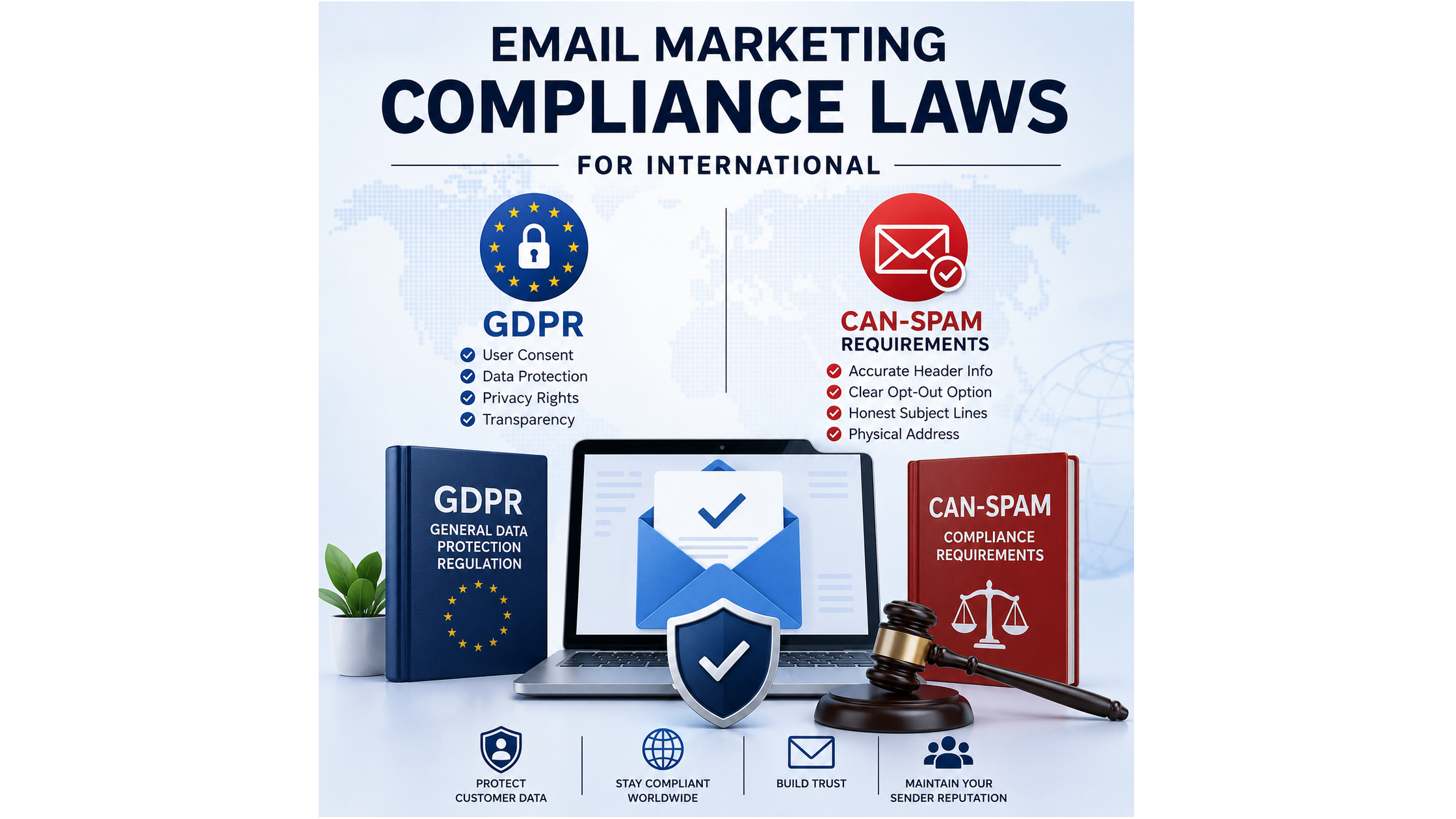
GDPR Demands Explicit Consent
The General Data Protection Regulation sets the global gold standard for strict email marketing compliance. GDPR requires that consent must be freely given, specific, informed, and unambiguous. Pre-ticked boxes don’t qualify as valid consent under these rules.
Under GDPR, businesses must demonstrate clear proof of consent for every email address on their lists. The regulation extends beyond EU borders, applying to any business that processes personal data of EU residents, regardless of where the company operates. This extraterritorial reach makes GDPR compliance necessary for most international marketing campaigns.
CAN-SPAM Allows Opt-Out Approach
The United States takes a fundamentally different approach through the CAN-SPAM Act. This legislation permits businesses to send emails to recipients until they explicitly request to stop receiving them. The opt-out model contrasts sharply with GDPR’s opt-in requirements.
CAN-SPAM focuses on truthful sender identification, clear subject lines, and easy unsubscribe mechanisms. While less restrictive than European standards, the law still imposes significant obligations on marketers, including honoring unsubscribe requests within 10 business days.
CASL Imposes Strict Canadian Standards
Canada’s Anti-Spam Legislation combines the strictest elements of both GDPR and CAN-SPAM. CASL requires explicit consent before sending commercial emails while maintaining stringent identification and unsubscribe requirements. The legislation applies to emails sent to Canadian recipients, regardless of the sender’s location.
CASL’s consent requirements are particularly demanding, requiring businesses to clearly identify themselves, explain why they’re collecting email addresses, and provide contact information at the point of collection. These standards are comparable to GDPR’s strictness and, in some specific areas, may even be more detailed.
Your Location Doesn’t Matter
One of the most important principles in international email marketing compliance is that regulations follow the recipient, not the sender. A business based in Singapore must comply with GDPR when emailing German customers, CASL when targeting Canadians, and CAN-SPAM for American recipients.
This principle eliminates any advantage from choosing business locations based on lenient email marketing laws. Global reach means global responsibility, requiring businesses to understand and implement the strictest applicable standards for their entire audience. The complexity multiplies when single campaigns target multiple countries with conflicting requirements.
Penalties Reach Millions Worldwide
Non-compliance with international email marketing laws carries severe financial consequences that can devastate businesses of any size. These penalties reflect regulators’ serious commitment to enforcing consumer protection standards.
1. EU Fines Up to €20 Million
GDPR violations can result in fines reaching €20 million or 4% of global annual turnover, whichever amount is higher. These penalties apply to any organization processing EU residents’ personal data, regardless of the company’s location or size. Recent enforcement actions demonstrate regulators’ willingness to impose maximum penalties for serious violations.
The regulation’s extraterritorial scope means even small businesses targeting European customers face these substantial penalty risks. Data protection authorities across Europe have shown increasing sophistication in identifying and prosecuting international violations.
2. Canada Charges CAD $10 Million
CASL violations can result in penalties up to CAD $10 million for businesses and CAD $1 million for individuals. Canadian regulators have consistently demonstrated their commitment to enforcement, pursuing cases against both domestic and international companies.
These penalties extend beyond simple spam violations to include inadequate consent documentation, improper unsubscribe mechanisms, and misleading sender identification. The broad scope of CASL’s requirements means businesses often face multiple violation categories simultaneously.
New 2025 Rules Add Complexity
Emerging regulations continue adding layers of complexity to international email marketing compliance. These new requirements address evolving technology and accessibility concerns while maintaining the fragmented approach that characterizes global email marketing law.
European Accessibility Act Requirements
The European Accessibility Act, effective June 2025, introduces new accessibility requirements for digital communications, including email marketing. These standards mandate screen-reader compatibility, minimum color contrast ratios, and alternative text for images in commercial emails.
Businesses targeting European customers must redesign their email templates and content creation processes to meet these accessibility standards. The requirements extend beyond simple compliance to include design principles that benefit all users.
Fragmented US AI Regulations Apply
Emerging FTC requirements mandate disclosure of AI use in personalized or automated marketing campaigns. These rules apply to businesses using artificial intelligence for content generation, personalization algorithms, or automated decision-making in their email marketing efforts.
The AI disclosure requirements add another layer of complexity to US email marketing compliance while other jurisdictions develop their own approaches to AI regulation. This fragmentation continues the pattern of conflicting international standards that complicate global campaigns.
Adopt Strictest Standards for Global Success
The most practical approach to international email marketing compliance involves implementing the strictest applicable standards across all campaigns. This strategy simplifies compliance management while providing the broadest protection against regulatory violations.
Adopting GDPR and CASL standards as baseline requirements ensures compliance with most international jurisdictions. This approach requires explicit consent collection, thorough documentation, and robust unsubscribe mechanisms for all campaigns, regardless of target markets.
Regular list maintenance, including removing invalid addresses and managing inactive subscribers, supports both deliverability and compliance objectives. Businesses should implement systematic approaches to consent documentation, data retention, and cross-border data handling to maintain compliance as regulations continue evolving.
The complexity of international email marketing compliance demands sophisticated tools and expert guidance—Brevo provides email marketing solutions designed to help businesses navigate global regulatory requirements effectively.
Brevo
106 Boulevard Haussmann,
Paris
Île-de-France
75008
France

