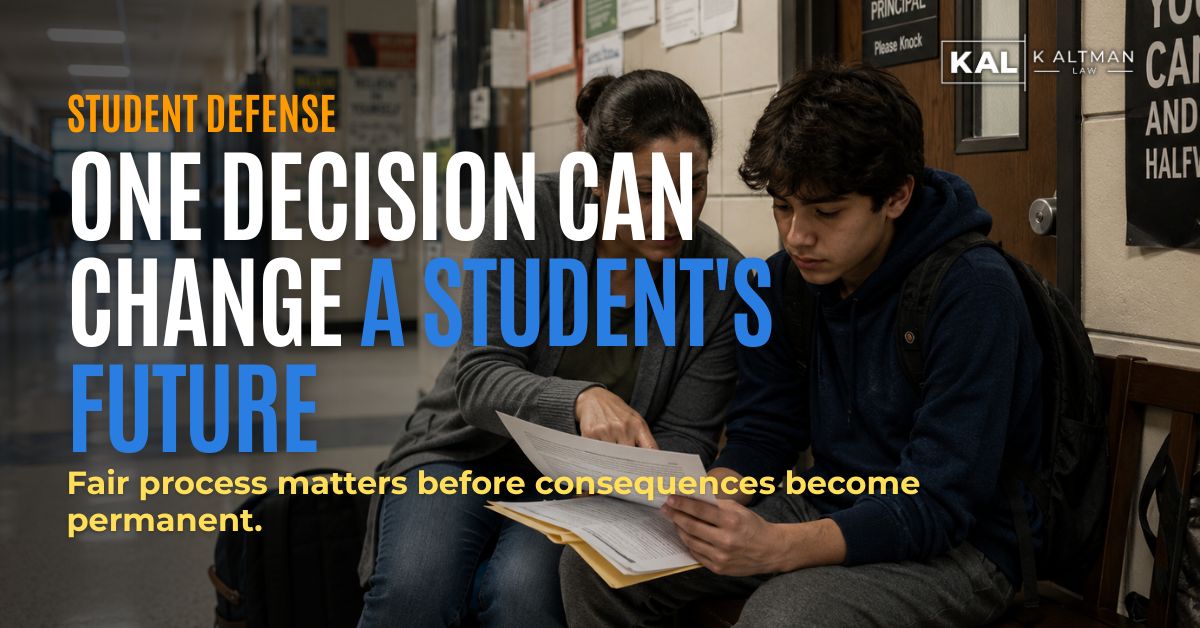
Federal discipline enforcement has changed—but students still deserve fair process before schools impose life-changing consequences.
WASHINGTON, DC, UNITED STATES, July 30, 2026 /EINPresswire.com/ — The U.S. Department of Education has removed disparate-impact provisions from regulations implementing Title VI of the Civil Rights Act, changing an enforcement tool long used to examine school policies that disproportionately burden racial or national-origin groups.
The Associated Press reported that the department will generally require intentional discrimination rather than disproportionate effect alone under the revised provisions. School discipline has been a central setting for disparate-impact analysis because national data has repeatedly shown unequal rates of suspensions, expulsions, and alternative-school transfers. [You can read about it here.]
The change is significant, but it should not be misunderstood. Title VI’s prohibition on intentional discrimination remains. Other federal laws, state civil-rights protections, disability laws, constitutions, student handbooks, collective policies, and contractual promises may also apply. Schools still benefit from clear rules and consistent documentation; students still need timely notice and a meaningful opportunity to respond.
“A shift in one federal enforcement theory does not make the underlying process unimportant,” said Keith Altman, founder and managing partner of K Altman Law. “A defensible disciplinary decision should identify the rule, explain the evidence, apply stated procedures consistently, and give the student a fair chance to be heard.”
Students and families confronting serious discipline should consider three immediate steps:
– Obtain the precise charge, code provision, evidence, hearing procedure, and sanction range in writing.
– Create a timeline and preserve communications, video requests, witness information, accommodation records, and comparison evidence.
– Calendar every conference, hearing, records request, and appeal deadline; deadlines are often short.
The revised federal rule does not decide whether a particular suspension or expulsion is lawful. The analysis remains fact-specific. Evidence of inconsistent treatment, biased statements, departures from policy, unreliable proof, or a failure to provide disability-related protections may still be important under the laws and rules that govern the institution.
K Altman Law represents students and families in K–12 and higher-education disputes involving discipline, due process, accommodations, discrimination, and institutional procedure. The firm’s approach emphasizes early fact development, careful documentation, and practical decision-making.
This release provides general educational information and is not legal advice. It does not create an attorney-client relationship. Legal rights and deadlines depend on jurisdiction, facts, and institutional policy.
Keith Altman
K Altman Law
+1 888-984-1341
kalonline@kaltmanlaw.com
Visit us on social media:
LinkedIn
Instagram
Facebook
YouTube
TikTok
X
Legal Disclaimer:
EIN Presswire provides this news content “as is” without warranty of any kind. We do not accept any responsibility or liability
for the accuracy, content, images, videos, licenses, completeness, legality, or reliability of the information contained in this
article. If you have any complaints or copyright issues related to this article, kindly contact the author above.

Media gallery