Rabbet’s eighth annual State of Construction Finance Report finds an industry adopting AI with unusual precision about its limits.
AUSTIN, TX, UNITED STATES, August 12, 2026 /EINPresswire.com/ — Rabbet today published its 2026 State of Construction Finance Report, its eighth annual survey of the people who finance and build real estate. This year’s edition lands against higher capital costs, trade-policy uncertainty, and steady pressure to do more with the same team.
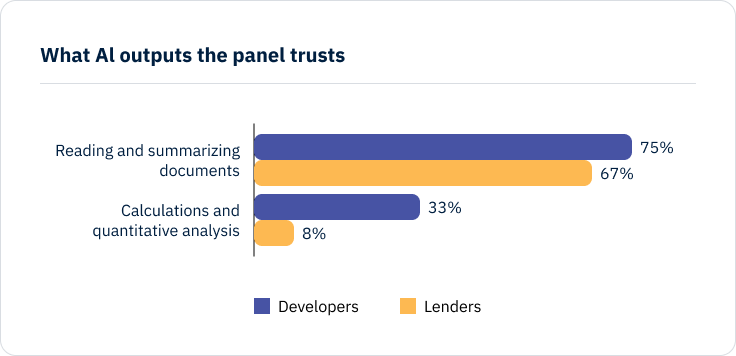
The industry has drawn a sharp line around what it will let AI touch. 71% of respondents trust AI to read and summarize documents. Only 21% trust it with calculations and quantitative analysis. The gap runs roughly two to one among developers and roughly eight to one among lenders, the side closer to the money. No respondent on either track described AI as deeply embedded in their day-to-day workflow, and the barriers holding adoption back are risk rather than return: accuracy and hallucination concerns at 67% and security and data privacy at 58%, against 8% citing unclear ROI.
“Teams trust AI to read a document and not to run the math on it, and that is the right instinct,” said Will Mitchell, CEO of Rabbet. “Reading a lien waiver and calculating cost to complete are different jobs. You can spot-check the first against the page in front of you. The second depends on a budget, a funding source, and a dozen documents living in separate systems. Large language models excel at reading. Math is deterministic and the risk is high. That is not an argument against the model. It is an argument for structuring what sits underneath it.”
The report also finds the two sides of a construction loan describing the same process differently. Developers report a median of 10 days from draw request submission to funding. Lenders report 6.5 days. No developer reported a draw request sent back for additional documentation on first review, while a quarter of lenders reported sending them back. 92% of lenders said delayed packages sit with the borrower. Not one named their own review queue.
“Everyone in construction finance agrees the draw process takes too long,” said Mitchell. “What this data shows is that we do not agree on where the time goes. Developers and lenders are rebuilding the same picture of the same project. That duplicated work is a hidden cost of construction. When information is structured and seamlessly shared, we can lower the cost of construction.”
Also in the report:
– Costs rose, contingency didn’t. 75% of developers reported material costs rising over the past 12 months, 73% higher insurance premiums, and 67% greater tariff and trade policy impact. 92% of lenders held their required baseline contingency flat and 58% of developers held allocations flat, with 84% of both sides sitting between 5% and 10%.
– Manual work absorbs the difference. 5 to 10 hours per person per week goes to manual document handling on both sides of the loan, close to a full business day.
– The pipeline is waiting on capital. 58% of developers have pre-development projects intentionally on hold. 50% of developers cite waiting for better funding conditions, against 17% citing demand.
– Standards are the closest thing to consensus. Only 8% on either side thinks draw packaging standards aren’t needed.
The 2026 State of Construction Finance Report is available now at rabbet.com/reports/state-of-construction-finance-2026.
Paco Banuelos
Rabbet
+1 828-962-3294
email us here
Visit us on social media:
LinkedIn
Legal Disclaimer:
EIN Presswire provides this news content “as is” without warranty of any kind. We do not accept any responsibility or liability
for the accuracy, content, images, videos, licenses, completeness, legality, or reliability of the information contained in this
article. If you have any complaints or copyright issues related to this article, kindly contact the author above.

Media gallery